How to Get Your WordPress Site Indexed by AI (ChatGPT, Gemini & Beyond)
Search is evolving from blue links to synthesized AI answers. Discover the 6-step technical blueprint to optimize your WordPress site for AI crawlers like ChatGPT and Gemini, ensuring your content becomes the trusted source for the next generation of discovery.

Words by
Ines Orinčić
The transition from traditional search engines to synthesized AI answers represents the most significant shift in digital discovery in over a decade. Users are increasingly bypassing the classic list of blue links in favor of direct, conversational answers from platforms like ChatGPT, Gemini, and Perplexity. In this new environment, visibility is no longer defined by a simple ranking; it is defined by being the trusted source that the AI cites to support its answers. When a user asks for a specific recipe, a travel itinerary for a vacation in Croatia, or a technical software comparison, they expect an immediate, high-fidelity response. If your WordPress site provides the core information for that answer, the AI provides a citation, a direct link that serves as the new number one ranking. This fundamental reshaping of information discovery is happening in real-time. To remain relevant, your digital infrastructure must be visible, legible, and authoritative to the AI crawlers that power these models.
The Strategic Shift: From Search Clicks to AI Citations
For years, digital growth was measured by the ability to rank on a search engine results page (SERP) and win a click. Today, that model has evolved. When an AI agent answers a query about the most secure way to configure a WordPress login page, it provides a concise, actionable summary gathered from multiple sources. If your content is the most structured and authoritative, the AI utilizes your expertise and links back to you as the primary source.
This shift represents a transition from being a book in a library to being the expert the librarian quotes directly. Contextual visibility establishes you as a trusted authority before the user even lands on your page. At Checkgrow, we focus on engineering growth systems where your content is not just found, but is deeply understood and utilized by the AI agents guiding modern consumer decisions.
Identifying the AI Gatekeepers: The Crawlers Behind the Answers
AI models access the live web through specific crawlers that work in tandem with major search indexes. Understanding these gatekeepers is essential for ensuring your WordPress site is properly indexed.
OpenAI and the Microsoft Ecosystem
OpenAI’s ChatGPT relies heavily on the Bing search index for real-time information retrieval. If your site is invisible to Bing, it remains invisible to ChatGPT’s live search features. The primary crawlers involved are:
OAI-SearchBot: OpenAI’s proprietary crawler used for fetching live content to generate real-time answers.
GPTBot: A crawler used to gather broader datasets for training future iterations of AI models.
Google’s Gemini and AI Overviews
Gemini utilizes the Google Search index to access the web. For your content to appear in Gemini’s synthesized responses or in Google’s AI Overviews, your site must maintain a perfect indexing status within the Google ecosystem. The critical crawler here is Google-Extended, which Google uses specifically to collect data for its AI models.
A 6-Step Technical Blueprint for AI Visibility
Achieving high-frequency indexing by AI agents requires a robust, machine-legible infrastructure. Use this roadmap to transform your WordPress site into a primary source for AI platforms.
1. Optimizing the robots.txt for AI Access
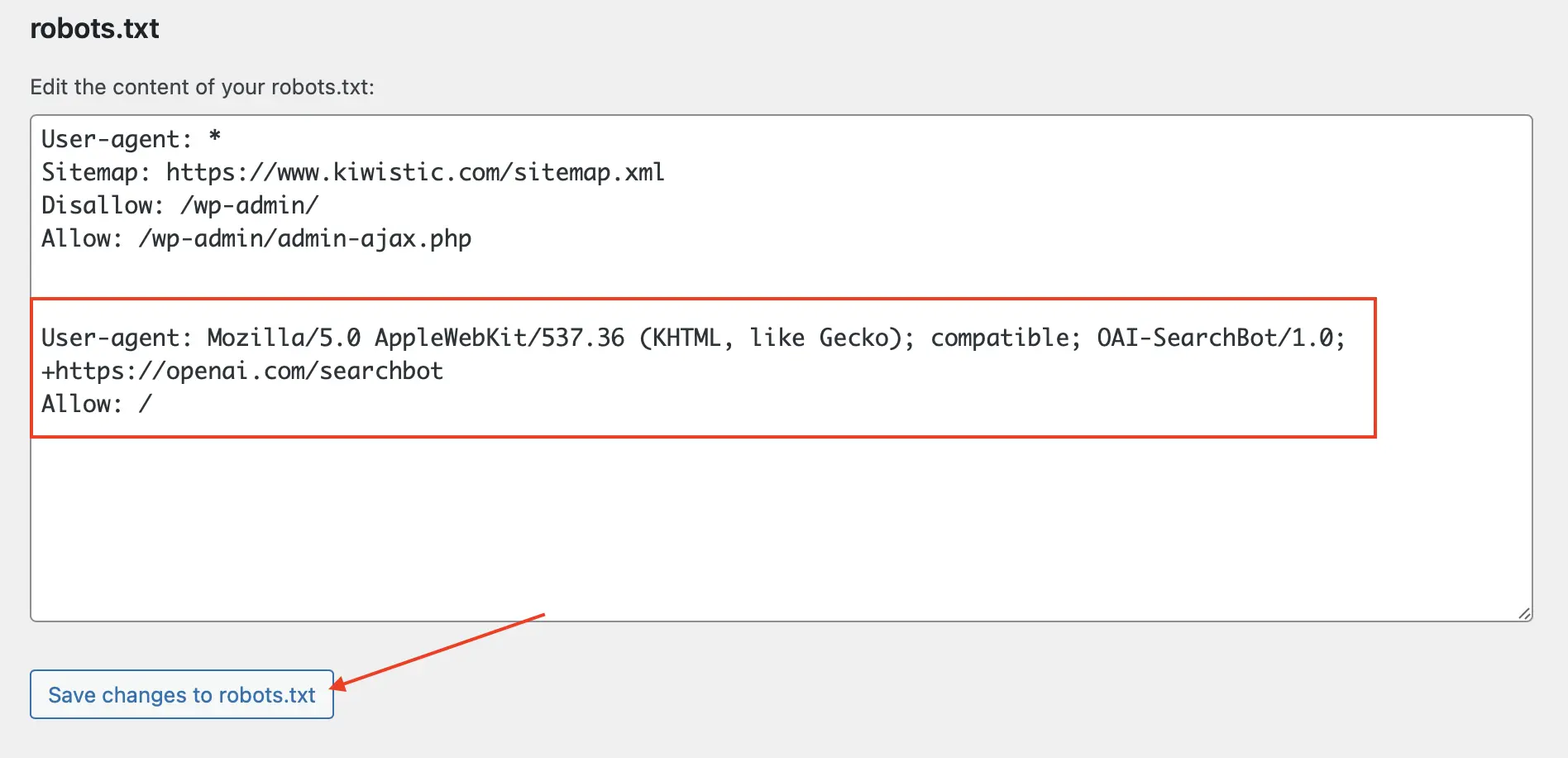
The robots.txt file is the first point of contact for any web crawler. Many default WordPress configurations are overly restrictive. To ensure AI agents can read your content, you must explicitly grant access to their specific user agents.
Access your robots.txt file via FTP or an SEO plugin like Rank Math and add the following directives:
(Note: Blocking GPTBot while allowing OAI-SearchBot ensures your site is used for live answers without necessarily contributing to the training of future models.)
2. Mastering Core Search Indexes
Your status within the primary search indexes directly dictates your AI visibility. AI crawlers utilize the Master Indexes of Google and Bing as their foundational maps of the internet.
Google Search Console (GSC): Ensure your XML sitemap is submitted and processing without errors. Use the URL Inspection tool to verify that key pages are successfully indexed.
Bing Webmaster Tools: Since ChatGPT relies on Bing, verifying your site here is non-negotiable. Bing offers an easy import feature directly from Google Search Console to simplify this process.
Canonicalization: Use
rel="canonical"tags correctly to prevent AI agents from pulling fragmented or duplicate content.
3. Engineering a Lightweight Digital Architecture
AI crawlers operate on a crawl budget. If your WordPress site is slow, cluttered, or technically bloated, these agents will prioritize faster, cleaner sources.
Semantic HTML5: Use a lightweight theme built on clean code (like Blocksy or GeneratePress). Proper tags like
<article>,<section>, and<nav>act as essential signposts for AI systems.Performance Optimization: Maximize page speed through premium caching (WP Rocket) and image optimization (ShortPixel). AI agents value efficiency and recency.
Internal Link Structures: Build a logical topical map. Interconnecting related content helps AI understand the depth of your expertise in a specific niche.
4. Structuring Content for Machine Readability
AI agents process data rather than reading for leisure. Your content should be structured like a structured database of answers.
Question-Based Headlines: Frame your H2 and H3 subheadings as the actual questions users are asking.
Atomic Content: Keep paragraphs focused on a single core idea, making it easier for AI to extract and cite specific snippets.
Schema Markup Mastery: Use Schema code to explicitly define your content. Prioritize
FAQPage,HowTo, andArticleschema. This code provides the AI with the exact context it needs to trust your data.
5. Strengthening Authority Signals (E-E-A-T)
In AI-driven search, trust is built through Topical Authority. Focus your content on a core set of related subjects to signal your expertise. Regularly update your most important articles to indicate recency; AI systems prioritize information that is current. Ensure every post has a clear author bio supported by Person schema, linking to established professional profiles to reinforce your credibility.
6. Measuring Success: The AI Visibility Dashboard
Tracking AI-driven visibility requires looking for specific digital footprints within your analytics and server logs.
Server Logs: Monitor requests from
OAI-SearchBotandGoogle-Extended. An increase in crawl frequency is a leading indicator of growing AI trust.GA4 Referral Segments: Create custom segments in Google Analytics 4 to track traffic where the session source matches
chat.openai.comorgemini.google.com.Long-Tail Branded Queries: In GSC, look for queries that include your brand name in an AI-style context (e.g., "how to do X according to [Your Brand]").
Engineering Discovery in the AI Age
Generative AI Optimization is a foundational shift in how we build for the web. We are moving toward a reality where your website acts as an API for AI agents. In this environment, a well-structured answer is more valuable than a traditional ad, and your authority directly influences a consumer's decision before they ever visit your site.
To win in the age of synthesized answers, your site’s structure, content, and authority must be perfectly aligned. By engineering a machine-legible infrastructure, you ensure that your business remains the trusted source for the AI agents that guide the future of search.
Are you ready to build a growth engine optimized for AI discovery? At Checkgrow, we design precision SEO systems that align your digital presence with the future of synthesized search.
Book a discovery call with us today to engineer visibility that leads to measurable growth.