Beyond the Stack: How Unified Data Systems Accelerate Growth
Data silos are silently draining your revenue and slowing your team down. Discover why adding more tools isn't the answer and how the shift to AI-powered agentic systems creates the unified data flow necessary for 2.5x faster growth.

Words by
Mira M.
Modern business leaders often operate in a state of digital dissonance. Marketing dashboards show record leads while sales pipelines appear stagnant. These conflicting stories are symptoms of a pervasive organizational challenge: the fragmentation of tools and the creation of data silos. Over the last decade, the best-in-breed approach to tech stacks has led to an operational landscape where critical information remains trapped. Strategic growth now depends on moving toward agentic, unified systems that turn fragmented data into scalable revenue.
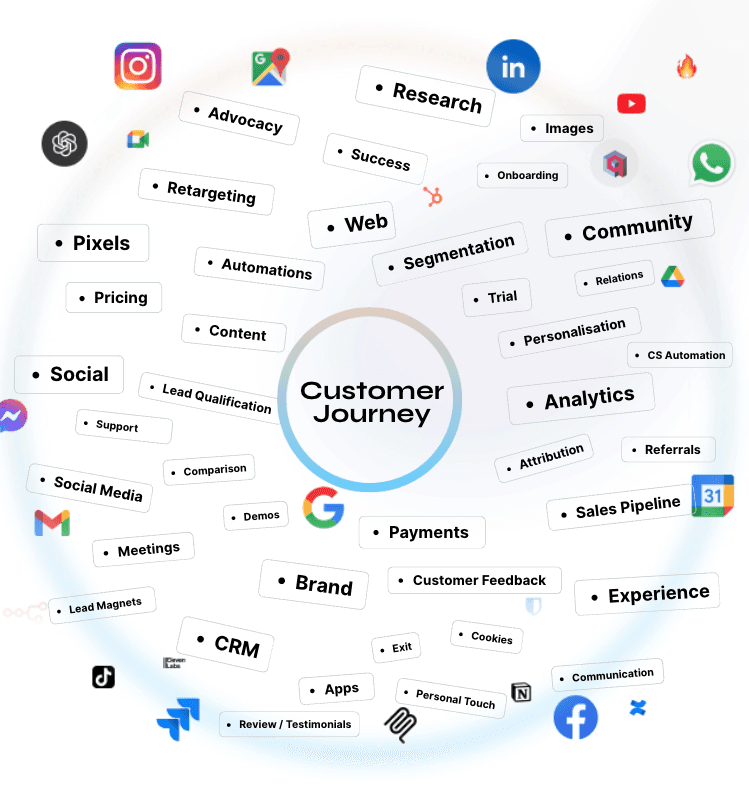
The Modern Tech Stack Problem
Most complex systems evolve gradually. Companies adopt a CRM for sales, a marketing platform for campaigns, and a helpdesk for support. Each decision serves a specific purpose in isolation.
The cumulative result is a disconnected tech stack lacking a central nervous system.
Research from Forrester indicates that enterprise marketing teams use an average of over 20 different tools.
Salesforce reports show that 70% of sales leaders experience fragmented data across disconnected platforms.
Valuable data remains locked in separate databases. Teams consequently spend significant time manually moving information between systems, reducing the time available for decisive action.
The Financial Impact of Fragmented Data
A unified view of the customer journey is essential for informed decision-making. Data silos create blind spots with direct financial consequences:
Misallocated Marketing Spend: Without sales feedback, marketing teams may fund campaigns that generate volume but lack conversion potential.
Jeopardized Renewals: Sales outreach remains disconnected from customer support history, leading to poorly timed upsell attempts.
Inconsistent Metrics: Leadership often receives conflicting reports from different departments, making it difficult to establish a single source of truth.
According to Gartner, disconnected systems cost organizations an average of $12.9 million annually. These losses stem from broken forecasts, misguided investments, and missed revenue opportunities.
The Human Cost: Friction and Misalignment
Data silos erode internal trust and hinder collaboration. When systems are disconnected, teams become misaligned:
Sales vs. Marketing: Attribution becomes a matter of opinion rather than shared data, fostering conflict over lead quality.
Reactive Support: Support teams lack visibility into the sales process, limiting their ability to prioritize high-value accounts.
Executive Overhead: Leadership meetings are frequently consumed by reconciling conflicting departmental metrics.
Accenture research found that 75% of executives observe departments competing rather than collaborating due to technology-induced silos. A unified system ensures customers experience the company as a single, organized entity.
Growth Velocity and the Another Tool Fallacy
Fragmentation acts as a lead weight on growth velocity, the speed at which a company attracts and retains customers. Every silo creates a delay. Manual data exports and imports extend sales cycles and slow down support resolutions.
A Harvard Business Review study highlights that companies responding to leads within one hour are seven times more likely to qualify them. In fragmented organizations, these benchmarks are often impossible to reach.
The instinctive reaction to these gaps is often adding more software. However, IDC research shows that in organizations with more than 10 applications, employees spend nearly 30% of their time simply switching between platforms. True leverage comes from unification, not further expansion.
From Fragmentation to Flow: The Rise of Agentic Systems
The shift from simple integration to agentic systems represents a new paradigm. Unlike passive connectors, agentic systems are AI-powered agents that operate across the entire stack, understand context, and execute complex workflows autonomously.
Marketing Agents: Automatically enrich new leads, check CRM history, and deliver qualified prospects to the right salesperson in seconds.
Support Agents: Monitor tickets in the context of renewal dates and CRM status, alerting success managers to high-priority issues proactively.
Reporting Agents: Sync metrics across all platforms in real-time, ensuring every dashboard tells the same story.
Unifying the GTM Stack for Collective Success
Unified, agent-driven systems deliver immediate and compounding business impacts:
Shorter Sales Cycles: Instant, context-rich follow-ups increase conversion rates.
Higher Marketing ROI: Real-time revenue data allows for precise budget allocation to the most effective channels.
Stronger Retention: A 360-degree view of the customer allows for proactive service and increased loyalty.
PwC research confirms that companies with unified data strategies are 2.5 times more likely to outperform peers in revenue growth. By deploying AI agents to bridge these gaps, Checkgrow helps businesses build a resilient, scalable operating system where data flows continuously and intelligently.
Ready to unify your tech stack? Reach out to our team to discover how agentic systems can eliminate silos and drive your growth velocity.