Acquisition Cost vs LTV: The Hidden Cost of Not Knowing Where Deals Come From
Acquisition cost vs LTV is the difference between lucky traction and scalable growth. Learn how to map deal channels, CAC, and scale safely.

Words by
Amir Babovic
Acquisition cost vs LTV is one of those topics founders think they understand, right up until they try to scale.
Early traction can hide a lot. Deals come in through a few easy channels, a couple of relationships, some organic posts, maybe a partner intro. It feels like momentum, but if you can't explain how deals happen, what channel they come from, and what it costs to acquire them, you're building a collection of wins rather than a growth engine.
This hidden expense includes everything from wasted marketing budgets to months of misguided product decisions and early hiring. Ironically, these compounding errors usually come to light right as you hit your highest point of confidence.
This article is for scaleups and founders trying to go from early traction to repeatable growth. It covers what breaks when you don't have clarity on acquisition cost vs LTV, and how an Iterative Growth Framework helps you create first, then understand the journey that converts, and only then earn the right to scale.
The Hidden Cost of Not Knowing How Deals Happen
Most teams can tell you what they're doing. They'll say they're posting on LinkedIn, publishing SEO content, running a few paid tests, and that sales is doing outbound. All of that can be true and still not answer the question that matters.
Ask a sharper question and you'll usually get a vague answer. Which channel is producing the deals that close? What's our acquisition cost by channel? What does it cost to create one sales qualified opportunity? What happens to payback if we double spend next month?
When the answer is it's a mix, it often means attribution is fuzzy, tracking is inconsistent, and nobody trusts the numbers enough to make a real call.
That uncertainty has a real cost. Teams end up scaling the loudest channel, not the most effective one. The channel with the most visible activity gets more budget, even if it's producing unprofitable pipeline. They also over-credit the wrong touchpoint. A deal might come in through a demo request, but the buyer's confidence might have been built earlier by an SEO page, a founder post, and a webinar. If you only track the last click, you'll invest in the wrong lever.
It also gets hard to tell whether growth is skill or luck. Early deals often include outliers: friend-of-a-friend intros, a buyer who was already in-market, or a perfect-fit customer who would have converted through almost any path. Those deals feel like proof. They're patterns worth questioning.
And then there's the cost founders underestimate most: time. When your deal sources are unclear, every growth conversation becomes a debate. Marketing says one thing, sales says another, the CEO goes with gut feel, and you lose a quarter.
The Winning Product You Can't Scale Problem
A product people love can still hit a scaling wall if the unit economics are shaky. Scaling success depends as much on financial clarity as it does on product-market fit.
Here's a scenario that's common in B2B. You have a strong product, customers are happy, and you're closing deals. Some came from referrals, some from organic LinkedIn, and some from inbound search. So you decide to add fuel: you hire demand gen, increase paid spend, and add SDRs.
Pipeline goes up, but costs go up faster. Close rates dip because the new leads are colder. Sales cycles stretch. Suddenly, the same product that felt like it was working now feels hard to sell.
The product itself is unchanged. What changed was input quality and cost structure.
That's why acquisition cost vs LTV is a growth reality check, as much as a finance topic.
Without clarity on acquisition cost vs LTV, you can't answer the one scaling question that matters: if we add $1 of cost, do we get more than $1 back, reliably, within a timeframe we can survive?
Acquisition Cost vs LTV Is the Scaling Gate
At a high level, the logic is simple. Acquisition cost (CAC) is what it costs to acquire a customer, and LTV is what that customer is worth over time. But founders get stuck because they treat CAC as ad spend divided by customers, and LTV as contract value. That's a starting point, but it doesn't reflect how deals happen in real life.
In B2B, acquisition cost includes the messy stuff. It includes people time across marketing, sales, and founders doing calls. It includes tools like analytics, CRM, and content systems. It includes creative and production. It includes paid tests that didn't work. It includes the drag of long sales cycles.
And LTV goes beyond the first invoice. It's retention and churn, expansion and upsells, and all the real-world friction like discounts, downgrades, and support load.
You don't need perfect numbers, but you do need numbers you trust enough to make decisions.
Because when you scale without clarity on acquisition cost vs LTV, you end up in one of two places. You under-invest in a channel that could have worked because the results look too expensive when you measure it wrong. Or you over-invest in a channel that looks cheap because you're ignoring the full cost of sales and the downstream churn.
Where Most Teams Go Wrong with Attribution
Most attribution setups are optimized for reporting rather than decision-making. They tell you what happened last, when what you need is a clear picture of what actually moved the deal forward.
In B2B, buyers don't move in a straight line. They bounce between touchpoints. They read, they ask peers, they lurk, they come back weeks later. A single deal can have ten meaningful interactions, and the source you see in the CRM is often just the last one that was easy to capture.
The goal is consistent attribution you can use to compare channels, understand tradeoffs, and run better experiments, something reliable enough to act on.
A Practical Way to Think About Acquisition Cost vs LTV
If you're trying to make acquisition cost vs LTV useful, start with the journey rather than a spreadsheet.
Pick one customer segment you want more of. Map the path from first touch to closed deal. Then write down the handful of steps that show up again and again. A prospect might find you through search, read two pages, see a founder post, join a webinar, request a demo, and then go dark for two weeks before coming back.
Once you can describe that path, you can start attaching costs to it, honestly, if not perfectly. That's how you stop arguing about channels and start comparing them.
The Minimum Tracking That Changes the Conversation
You don't need a complex attribution model to get value. You need a few inputs that are consistently captured.
At a minimum, teams should be able to answer: what was the first meaningful touch, what was the last meaningful touch, and what were the one or two interactions that clearly moved the deal forward.
If sales is logging calls and marketing is tracking content performance, you can connect those dots. The goal is to reach a point where you can say with confidence: this segment closes when they see X, and it gets expensive when we rely on Y.
How an Iterative Growth Framework Keeps You From Scaling Noise
An Iterative Growth Framework is simple: you create, you observe, you learn, and you scale. But the order matters.
Many teams default to scaling first. They pick a channel, throw budget at it, and hope the numbers will reveal themselves. Running smaller, controlled tests designed to answer one question at a time is what moves the needle: which message pulls the right segment in? Which channel produces sales conversations that progress? Where do deals stall, and what unblocks them?
As you learn, you tighten the system. You standardize tracking. You define what good looks like for pipeline quality, not just volume. Then, when you increase spend or headcount, you're scaling something you understand.
What This Looks Like in a Scaleup Team
In practice, this means marketing and sales stop operating as separate worlds. They agree on definitions — like what counts as a qualified opportunity and what counts as a meaningful touch. They review a small set of metrics together, regularly. And they treat channel performance as something to diagnose together.
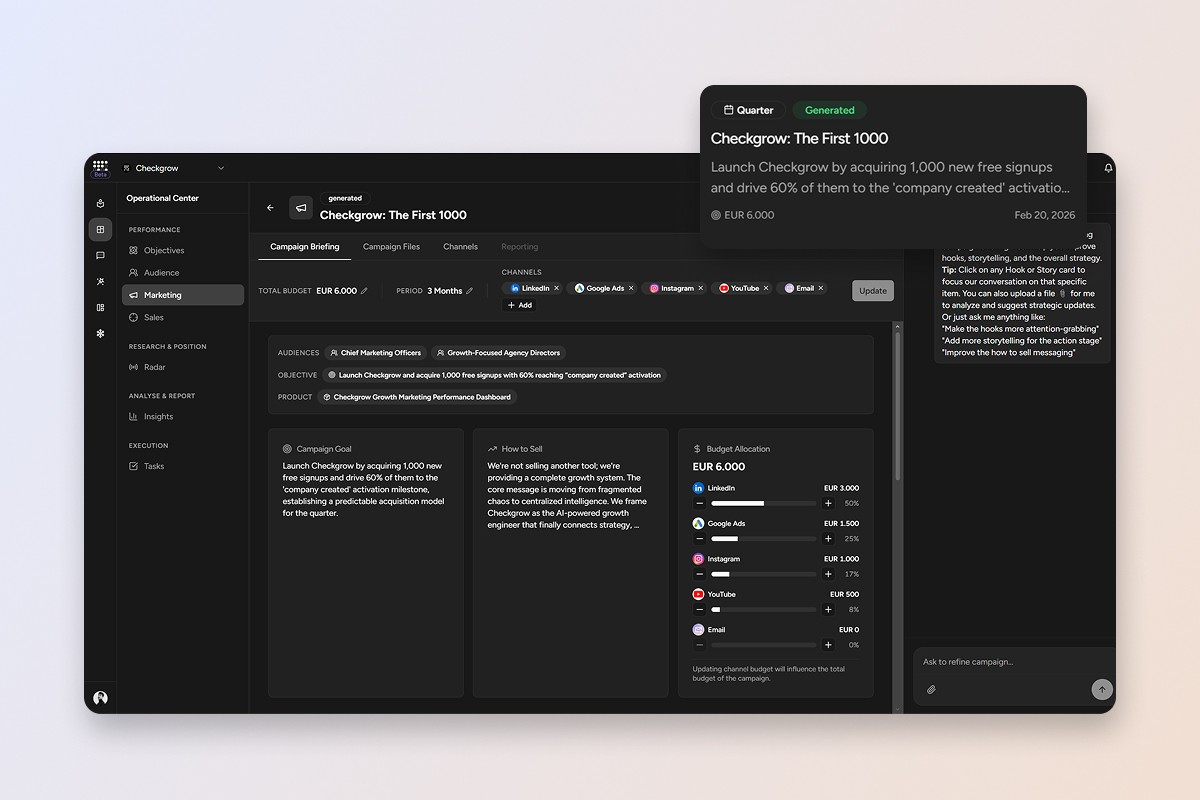
This is also where a system like the Checkgrow Growth Marketing Performance Dashboard earns its keep. If you're trying to connect channel activity to pipeline and unit economics, you need one place that pulls the story together, what turns into revenue, what it costs, and how that changes when you shift the channel mix.
The Questions You Should Be Able to Answer Before You Scale
Before you add spend or hire ahead of revenue, you should be able to answer a few questions without hand-waving.
Which channels consistently create opportunities that close? What's the acquisition cost vs LTV by segment? How long is payback, and what happens if conversion drops a bit? Where are we relying on founder effort that won't scale? And which parts of the journey are doing the heavy lifting right now?
If you can answer those, scaling gets calmer. You still take risks, but they're informed risks.
Closing Thought
Acquisition cost vs LTV is a lens you use to decide what to build, what to stop doing, and what you've earned the right to scale, and it stays useful at every stage.
If you're at the stage where traction is real but repeatability still feels fuzzy, focus on clarity first. Map the journey, tighten attribution, and make the economics visible. Then scale.
And if you want a faster way to connect channels, pipeline, and unit economics without stitching together five tools and a dozen spreadsheets, Checkgrow's Growth Marketing Performance Dashboard is built for exactly that problem.