9 Growth Mistakes Silently Costing You Millions, and How to Fix Them
Is your growth stalling despite your team's best efforts? Discover the 9 hidden operational mistakes, from unstructured knowledge to vanity metrics, that are silently draining your revenue, and learn how to build a friction-free system designed for true scale.

Words by
Bruno Mucheroni
In every boardroom and investor meeting, the conversation inevitably centers on one thing: scale. Rapid growth is the primary objective for modern B2B SaaS companies and enterprises, yet many find their momentum stalling despite significant effort and investment. This stagnation is rarely due to a lack of hard work or talent; rather, it is the result of subtle, hidden operational leaks that quietly drain the system's efficiency. At Checkgrow, we view growth as a fluid process that requires a friction-free environment. When a company's growth engine is compromised by small, repeated errors, the cost compounds over time, leading to inflated acquisition costs and missed revenue targets. By identifying and resolving these nine common growth mistakes, leadership teams can move beyond the hustle and build a resilient, agentic system that facilitates sustainable expansion.
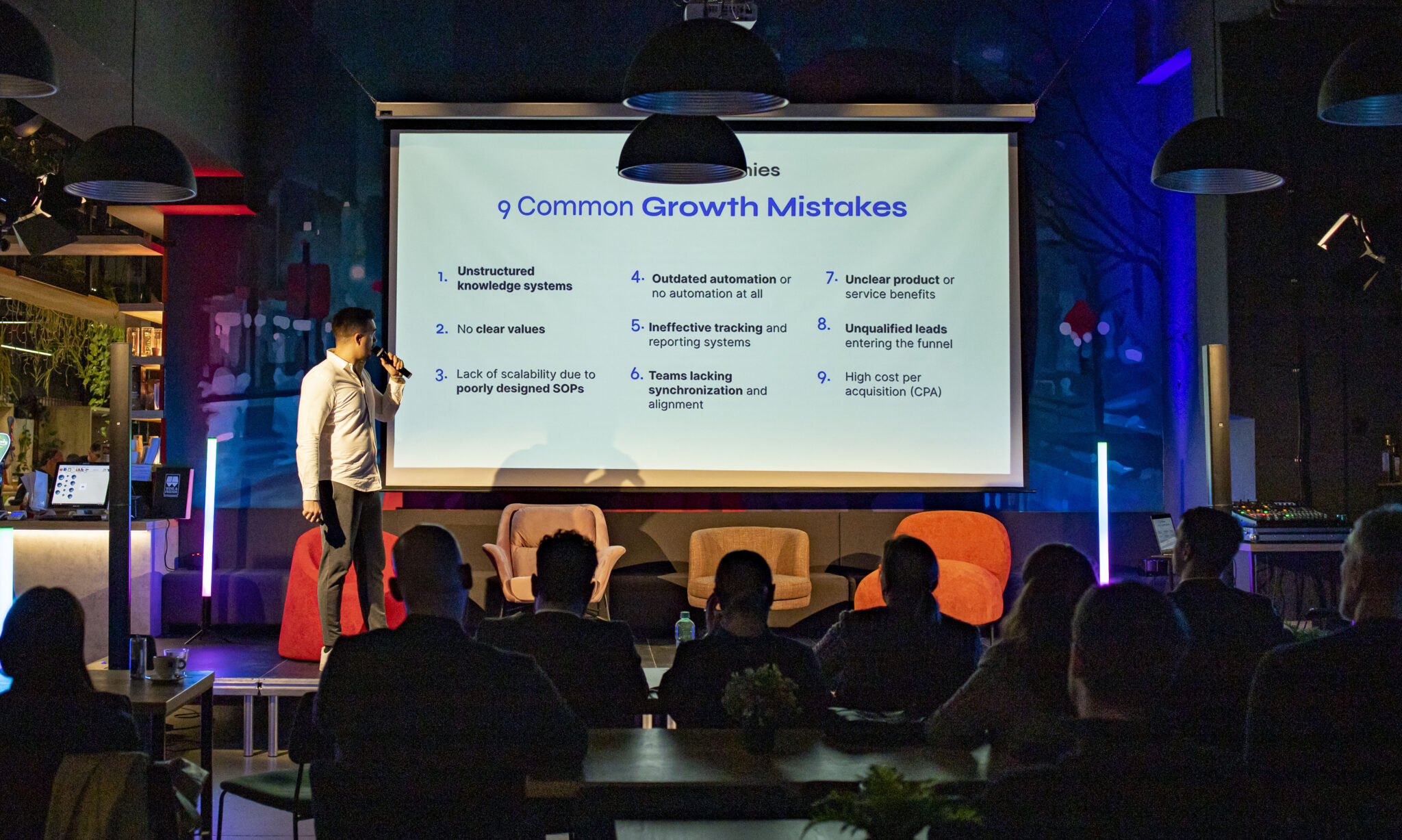
1. Unstructured Knowledge: The Cost of a Fragmented Corporate Brain
Information is the primary fuel for organizational speed. However, in many scaling companies, this fuel is scattered across thousands of Slack threads, buried in old email chains, or trapped within the minds of a few key individuals. When critical knowledge is not centralized, simple decisions take days, and the same mistakes are repeated every quarter.
The real cost of unstructured knowledge is most evident during onboarding. A new hire might spend their first month navigating a treasure hunt for information instead of contributing to the company's goals. To fix this, leadership must establish a single source of truth. By documenting critical processes in a shared, organized space like Notion or Confluence, and supplementing them with quick video walkthroughs, you ensure that the company's brain remains intact even as the team grows. Speed is a byproduct of clarity.
2. Decorative Values: Turning Wall Art into Actionable Rules
Core values are often dismissed as sweet-sounding words for a careers page, but their true purpose is to serve as the decision-making framework when the playbook runs out. Without clear, actionable values, departments often work at cross-purposes. For instance, a sales team prioritizing speed might promise custom features that the engineering team, prioritizing stability, must ultimately reject.
This internal friction creates a collection of talented people rowing in opposite directions. To move as one, a company must translate its 3-5 core values into expected behaviors. For every value, ask: "What does this look like in action?" If a value helps an employee make a difficult choice without needing managerial approval, it is an effective tool for growth. Values are the operating system for decentralized decision-making.
3. Rigid SOPs: Building for the Future, Not Just the Present
A common pitfall for scaling startups is writing Standard Operating Procedures (SOPs) for the team they have today, rather than the one they intend to build. A checklist that functions perfectly for a five-person team will inevitably grind a fifty-person organization to a halt. When processes are too rigid, they stifle human judgment; when they are too loose, the customer experience becomes inconsistent and trust is eroded.
The solution is to build flexible frameworks rather than rigid rules. Instead of a word-for-word sales script, for example, an effective SOP provides a framework of key discovery questions and mandatory benefits. This approach ensures high-quality output while allowing room for the professional expertise of the team. By focusing on the why and the what, but allowing flexibility in the how, you create a process that scales with your ambition.
4. Outdated Automation: Tending the Digital Garden
Automation is intended to be a super-enhancer for productivity, yet it frequently becomes an anchor. Systems built years ago often fall out of sync with current business operations, leading to broken workflows where hot leads disappear into digital black holes. Instead of saving time, outdated automation creates manual workarounds that waste hours of productive time.
To maintain a high-performance growth engine, automation must be treated like a garden that requires regular tending. Implementing a Quarterly Automation Audit ensures that every key workflow, from lead nurturing to customer onboarding, is tested and confirmed to be functioning as intended. Regular maintenance prevents the accumulation of technical debt and ensures your technology continues to support your growth rather than hindering it.
5. The Vanity Metric Trap: Tracking for Impact, Not Appearances
You cannot optimize what you do not accurately measure, but measuring the wrong data is often more dangerous than not measuring at all. Many dashboards are populated with vanity metrics, clicks, impressions, and follower counts, that look impressive but lack a direct connection to revenue or retention. Relying on misleading data leads to poor strategic investments in channels that feel busy but remain unprofitable.
Effective tracking requires every metric to be connected to a specific business outcome. For every number on your dashboard, ask: "Does this help me make a decision about budget, strategy, or people?" Shifting focus from website visitors to demo requests from qualified companies, and from sign-ups to Customer Lifetime Value (LTV), provides the clarity needed to make high-stakes growth decisions with confidence.
6. Lack of Synchronization: Aligning the Relay Race
Growth is a relay race, not a series of individual sprints. Marketing, Sales, Product, and Customer Success must pass the baton seamlessly to maintain momentum. Often, however, these teams operate in silos, unaware of each other's challenges or objectives. Marketing may generate leads without considering Sales capacity, while Product may develop features without input from the Success team.
This lack of synchronization causes momentum to stall at every handoff. The fix is to create shared goals and shared data rather than simply adding more meetings to the calendar. A shared dashboard allows Marketing to see the ultimate revenue impact of their leads, while Sales can identify which campaigns attract the best-fit customers. When every department is focused on the same scoreboard, they begin to operate as a single, high-performance team.
7. Selling Features Instead of Solutions: The "So What?" Test
Even the most brilliant product remains invisible if its value cannot be explained in a single, simple sentence. Sales pitches that rely on technical jargon and a long list of features often lead to extended sales cycles and lost deals. Potential customers are not looking for AI-powered analytics; they are looking for a way to save ten hours a week so they can focus on growth.
To clarify your product's benefits, apply the "So What?" Test. For every feature you mention, keep asking "So what?" until you arrive at a tangible, human benefit. When you stop selling the how and start selling the solution, you reduce friction in the buying process and allow your customers to see the immediate value of your offering.
8. The High Cost of Unqualified Leads: Prioritizing Fit
Flooding your pipeline with unqualified leads is one of the most expensive mistakes a scaling company can make. It forces your sales team to waste their most valuable resource, time, on prospects who are unlikely to convert. This leads to skyrocketed acquisition costs, plummeted morale, and a brand reputation that can feel intrusive rather than helpful.
A high-performing funnel acts as a bouncer, not just a greeter. By qualifying leads aggressively at the top of the funnel through disqualifying questions on sign-up forms and behavioral lead scoring, you ensure your team focuses only on high-intent prospects. It is far more profitable to engage with ten high-quality leads than to chase one hundred mediocre ones. Precision always outperforms volume in a mature growth strategy.
9. High CPA: Treating the System, Not the Symptom
A rising Cost Per Acquisition (CPA) is rarely a localized marketing problem; it is a systemic business challenge. High CPA is the final, painful symptom of all the previous mistakes combined. If your teams are misaligned, your benefits are unclear, and your sales reps are chasing bad leads, your acquisition costs will naturally escalate.
Instead of searching for cheaper clicks, focus on fixing the underlying system. Look at your CPA as a health score for your entire growth engine. When you organize your knowledge, clarify your values, and align your departments, your acquisition costs will naturally decrease as the efficiency of your entire operation improves. Scalability is about the health of the system, not just the size of the ad spend.
Conclusion: Building for Flow
Growth does not stall because of a single catastrophe; it erodes through a thousand tiny cuts, the small, repeated mistakes that create friction in your operations. The path to overcoming these hurdles does not require more hustle, but rather better systems.
At Checkgrow, we specialize in building agentic growth engines that remove these roadblocks and align teams for collective success. By transforming your operational foundation, growth stops being a struggle and begins to flow with ease.
Which of these nine gaps is currently holding your team back?
Book a strategy call with us and let’s build a system that turns your growth potential into a measurable reality.